

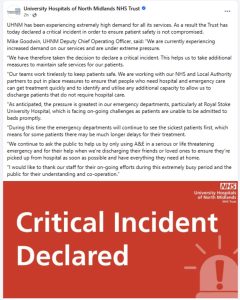
News reports trumpeting the reduction of England’s waiting list back to below 7.4 million (a reduction of 1.2%) were largely drowned out of media attention by a wave of “critical incidents” in which hospitals in Surrey, Kent, Warwickshire, two in Nottinghamshire, and Stoke on Trent admitted they could not cope with demand for emergency care.
However, there is no official list of critical incidents. It seems there have been more. The Royal College of Emergency Medicine (RCEM) is quoted as saying there were as many as 23 across the country, with “doctors at a further 19 arguing that they should have as well.”
On January 15, the RCEM described Emergency Departments (EDs) as being “in a state of desperation, frustration and exhaustion,” with too few staff and beds to deal with the combined pressure of normal winter emergency caseload, swollen further by an average of almost 3,000 (2,725) flu cases and a new upsurge of the “2-bucket” vomiting bug norovirus.
Sherwood Forest Hospitals FT in Nottinghamshire stood down a critical incident on January 16, but warned its hospitals “remain exceptionally busy”. It put the crisis down to sustained pressure on services and “insufficient discharges to meet the demand of patients waiting to be admitted”. In other words a shortage of beds.
The A&E department at Queen’s Medical Centre (QMC), run by Nottingham University Hospitals Trust, has also declared a critical incident. The Nottingham Post reports that each day in the first week of January, the QMC faced more than double the number of patients it can deal with. Its emergency department is designed to handle around 350 patients over a 24-hour period, so its clinical spaces can accommodate 131 patients at any given time. But this assumes most patients do not need to stay in A&E all day.
However, QMC’s overall daily intake into its emergency department has been averaging around 508 patients since the start of January, hugely exceeding its 131-space capacity at any given time. And this has meant people have been stuck on trolleys in the department’s corridors. In a classic understatement, NUH’s chairperson, Nick Carver, said the system was not working “optimally”.
It was a similar story in north Surrey, where Ashford and St Peter’s Hospitals FT declared a Critical Incident on January 13, primarily driven by a high number of attendances at the Emergency Department and a lack of available inpatient beds.
According to a January 12 RCEM survey of clinical leads in 81 EDs in England, the average longest wait for a bed was over 48 hours on Monday: “… across these departments, 41.5% of all patients were waiting for a bed on a ward. These patients are essentially stuck – they no longer need to be in ED, but there’s no available bed for them to move into.”
Even where it appears no critical incident has been called the situation is dire. In Arrowe Park Hospital’s emergency department in Merseyside, for example, attendances have been around 30 per cent higher than expected for this time of year. One unfortunate pensioner was brought in by an ambulance and placed on a trolley in a busy corridor. But staff were so overwhelmed that she died alone, without being seen.
A staff member told the Liverpool Echo:
My colleagues were absolutely distraught. They were broken hearted.
She added:
I am surprised it has taken this long for this to happen, and it is bound to happen again. We are failing our patients and they are coming to harm.
An A&E staff member told the Echo reporter:
This winter has been absolutely awful. We have got more and more patients on corridors. We haven’t got enough staff to cover these corridors, so patients sometimes have no one caring for them. …The numbers are so high and the skill mix we have is so poor. We have been overstretched. We can have 40-50 patients on a corridor or in escalation areas at times. They [Trust management] just keep opening more areas.
We are coming in and expected to look after 10 or 12 patients. It is supposed to be one to four. How are you supposed to nurse 10-12 patients on a corridor?
This story has been relayed to news audiences far and wide: The Lowdown found it in a local paper in Stoke on Trent.
There were concerns at the short-staffing and lack of care well before the winter brought its grimly predictable additional pressures. Back in September a 75-year old head injury patient who had been on a trolley in a corridor for 33 hours in William Harvey Hospital in Kent, waiting for a bed, was allowed to walk, disoriented, out of the hospital – and vanish for almost two days, before he was found in a ditch, dehydrated and with hypothermia.
We have reported elsewhere in the Lowdown that a change of policy to reduce ambulance handover times has increased the pressure on emergency departments, and run alongside a shocking increase in “corridor care”.
But of course, hospital trusts have been unable to prepare for the change by opening additional beds and recruiting more staff due to the tight financial squeeze imposed by NHS England, and endorsed by Health Secretary Wes Streeting.
University Hospitals Morecambe Bay, for example, has resorted to closing a 24-bed ward at Royal Lancaster Infirmary (RLI) and axing 18 beds across three large wards at Furness General Hospital – to save the pitiful total of £768,000. The Trust is also hoping to discharge 40 of its 170 patients with “no criteria to reside,” but increase the number of virtual beds by 25 to 73 by the end of March.
Cuts in rates of pay for bank staff, who in many sectors keep services going, have also been announced. A statement from the Trust blames the changes on the “huge financial challenge”: UHMB is expected to miss its 2025/26 target by £4m.
But as hospitals struggle to cope with the demand for emergency patients, financial pressures are also leading to decisions to seek savings away from the threat of negative press headlines, by cutting back on numbers of waiting list patients, especially those sent to the private sector.
Back in December, a BBC report noted:
Access to hospital treatments is being restricted in many areas of England as the NHS struggles to balance its books …. Regional health boards [by which the BBC means Integrated Care Boards, ICBs] have ordered some hospitals to cut back on the number of patients they are seeing, meaning hundreds of thousands of patients could have to wait longer for treatment.
The rationing measures are being applied mainly to private firms doing NHS work, but multiple NHS hospitals are understood to be affected too.
This is despite the fact that Wes Streeting would have us believe “Reducing waits for things like hip and knee operations and hitting the 18-week waiting time target is the government’s number one priority for the health service.”
But Mr Streeting also wants to wipe out Trust and ICB deficits. He has told NHS England to drive through “efficiencies” and cutbacks of £6.6 billion to balance the books.
And that is the pressure the management feels most strongly. So ICBs, which are in charge of spending on behalf of NHS England, have been asking hospitals to make patients wait longer, and reduce the numbers they treat until the end of the financial year.
According to the BBC: “One [ICB] asked a private provider to reduce activity by nearly 30% and to make patients wait eight weeks longer, on average,” and to stop taking on new referrals for a period as a way to cut back on the amount being done.”
So with delays in both emergency care and elective treatment, the government policy is failing to deliver on its one remaining promise on health (to reduce elective waiting times to the 18-week maximum achieved in 2009-10), while stirring a hornets’ nest of hostile press coverage as it also fails to deal with the most serious emergencies.
The number of individual patients waiting has been reduced to 6.17 million (a reduction of 1.1%) in November. It’s a sign of the hard work and dedication of NHS staff. But the political damage done by failures to improve emergency services is far greater and more wide-reaching than any good news on waiting times.
Streeting has not got long to turn the corner. With May elections looming, the government that won a hefty parliamentary majority seems likely to pay a heavy political price for its failure to face up to the problems it inherited after 14 years of massive underinvestment in the NHS.
Time is running out to take the action needed to get good news from the NHS, before the next general election topples Labour and quite possibly opens the door to Reform – a party which threatens the very existence of the NHS as a public service.

Dear Reader,
If you like our content please support our campaigning journalism to protect health care for all.
Our goal is to inform people, hold our politicians to account and help to build change through evidence based ideas.
Everyone should have access to comprehensive healthcare, but our NHS needs support. You can help us to continue to counter bad policy, battle neglect of the NHS and correct dangerous mis-infomation.
Supporters of the NHS are crucial in sustaining our health service and with your help we will be able to engage more people in securing its future.
Please donate to help support our campaigning NHS research and journalism.
