
They are at it again. Almost two years after The Lowdown reported East London Foundation Trust (ELFT), one of the capital’s largest and wealthiest mental health trusts, was attempting to cut spending by £29m and putting the quality of services at risk (with the potential loss of up to 365 posts, including adult and child and adolescent services).
Now we hear from Unite members that the Trust are coming back again – for a similar round of cuts.
The Trust is one of the two largest mental health trusts in London. It provides a wide range of community and inpatient services to children, young people, adults of working age, older adults and forensic services to the City of London, the London Boroughs of Hackney, Newham, Tower Hamlets, … and to Bedfordshire and Luton.
ELFT also provides forensic services (patients in the criminal justice system or who pose a high risk of harm to others) to the London Boroughs of Barking and Dagenham, Havering, Redbridge and Waltham Forest, some specialist mental health services to North London, Hertfordshire and Essex and Primary care services through two GP practices in Bedfordshire and three GP practices in east London that support homeless people with complex issues.
ELFT’s website says it employs over 7700 permanent staff, operates from over 120 community and inpatient sites and has 900 general and specialist inpatient beds, with annual income of just under £744 million. It might also have mentioned that (according to its July Trust Board papers) ELFT has £151 million cash balance.
The two mental health trusts (ELFT and NELFT) are the only trusts in North East London delivering a balanced budget without receiving any deficit support.
So ELFT has no financial crisis that might justify hacking back on staffing levels: nonetheless the Trust’s target this year is another £24.9m of cuts (£20m plus an extra 20% margin in case some measures fall short).
Staff have been told another 330 whole time equivalent (WTE) posts have been targeted as the main way to save money – at the expense of the quality of care for patients and increased pressure on remaining staff.
The changes are being ludicrously branded as the Trust’s “Going Further, Going Together” (GFGT) initiative, a label that seems to convince only gullible Trust Board members, who, like the staff on the ground, have been starved of any information – with none appearing in May or July’s Board papers. In May the Trust’s Finance, Business and Investment Committee (FBIC) reported only that they had been
“assured of clear plans supporting the delivery of efficiencies from the year end Going Further, Going Together (GFGT) savings programme figures …” (p187)
However no details of the latest plans for job losses appear to have been shared with the FBIC or Board, who seem to have been willingly persuaded that
“the work to achieve a cultural shift around efficiencies and productivity has provided opportunities to move forward at pace.”
This skirts neatly round the fact that staff and their union reps have been excluded from the “cultural shift” and (like the Board) left in the dark on which jobs, are to be axed to save money (and where).
The claim to be “Going Further, Going Together” is especially ridiculous because this time the Trust, which has the motto “We Care, We Respect, We are Inclusive” is once again showing that all these fine words are simply hot air, and none of it applies to its treatment of its own staff.
According to information the Trust gave the staff side, many of the 330 jobs to be lost are clinical posts, with 137 to come from an unspecified “redesign” of key services:
- 36 from Child & Adolescent Mental Health Services (CAMHS)
- 24 from Adult Mental Health
- 50 from Community Health Services
- 27 from Adult Mental Health (Community)
Another 149 job losses are supposed to come from other equally unclear changes that give no detail on which staff, or what their roles may be:
- 83 from ‘Target Operating Model’
- 26 from ‘Digital optimisation’
- And the loss of 40 WTE ‘Temporary’ staff
Smaller specified cutbacks (aka “redesign”) in other departments (including Specialist Children & Young People’s Services, Talking Therapies and Adult Mental Health Crisis) would axe another 33 WTE. How any of this could do anything but undermine the quality of care is not explained.
Among the services known to be facing cuts, Fothergill Ward, providing 8 Community Health beds for physical health patients in East Ham is set to close, and there are cuts in Tower Hamlets Psychology services and Newham CAMHS. The impact of other cuts has not yet been revealed.
However staff have told Lowdown that no other details have been provided of which jobs are to be cut, what the “redesign” consists of – or how those job losses add up to the claimed cash-saving listed as GFGT.
The Trust has already cut spending by an estimated £70m in two years since the GFGT initiative began. It claims in its July Board papers to have reduced its funded establishment by 287 WTE from 8,179 in May 2025 to 7,891 in May 2026. 664 of these remaining posts are vacant, covered by 643 WTE Bank staff and 67 WTE Agency staff – and the Trust is once again seeking to cut back on the use of temporary staff.
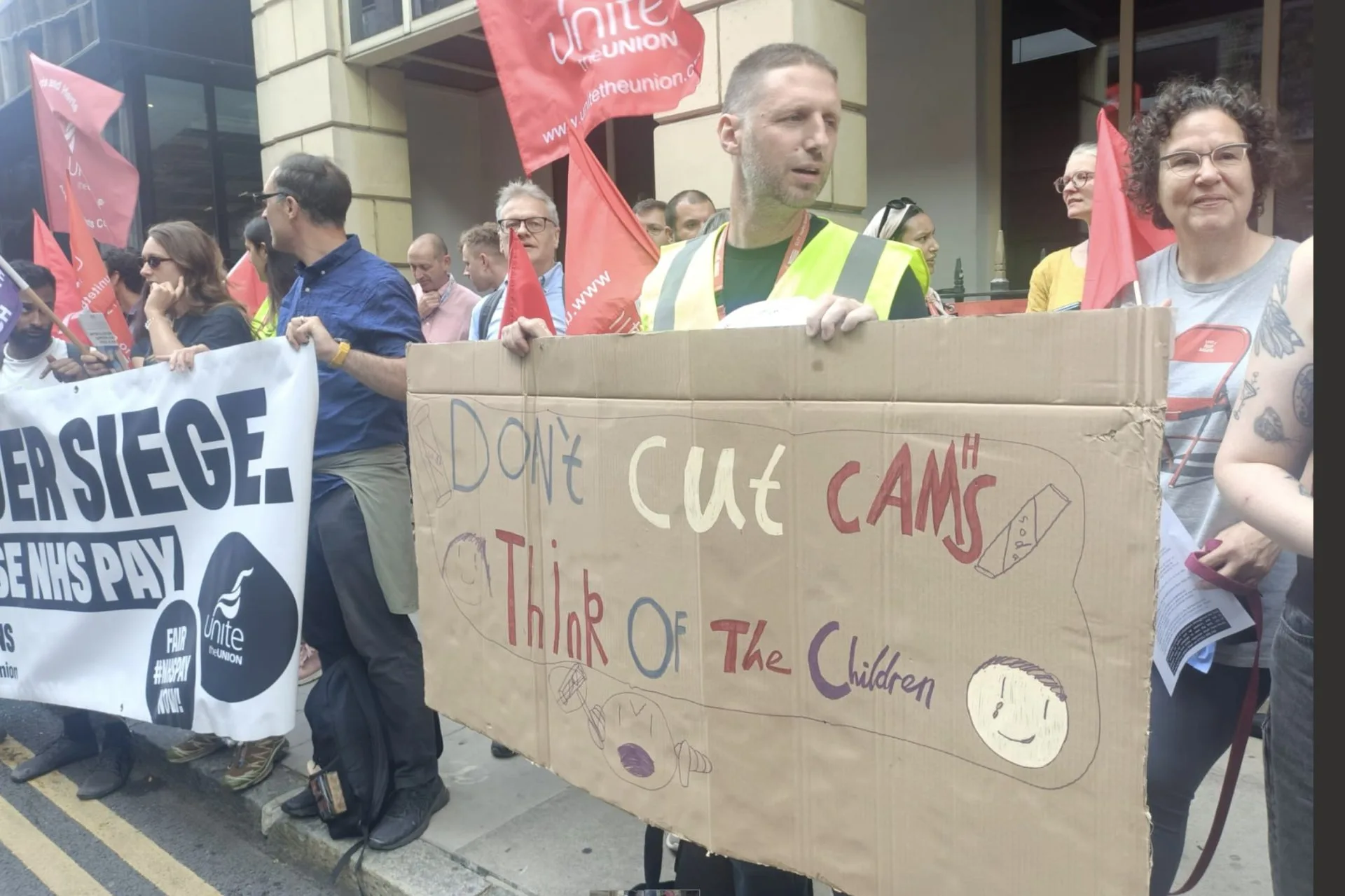
ELFT is so far not only once again refusing to consult with public or staff on the cuts (or “redesign”), but this time it has added a nasty new dimension – by including Unite’s leading representative, Mark Dunne, in the redundancies, and refusing the union’s attempt to negotiate on this.
Unite staged a lively demonstration in defence of Mark Dunne outside the Trust’s Aldgate HQ on July 23. According to staff who attended the protestors were told they could not ask questions of the meeting, but could put questions in writing: they did so, but neither question was answered in the meeting, and the Board said only that there would be a reply some time in the future.
There are real fears that the Trust may be determined to tough it out and continue to force through its cuts regardless of the views of staff, patients and the public.
Unite has launched a petition in his support of Mark Dunne, and is seeking the widest possible support in defence of trade union representation in the Trust.
* The Lowdown is grateful to NHS staff for sharing the information on this cutback; please share your information on the impact of “efficiency savings” or outright cuts, closures and disinvestment on local services to let us have whatever details you can so that we can help to share the knowledge and build resistance.

Dear Reader,
If you like our content please support our campaigning journalism to protect health care for all.
Our goal is to inform people, hold our politicians to account and help to build change through evidence based ideas.
Everyone should have access to comprehensive healthcare, but our NHS needs support. You can help us to continue to counter bad policy, battle neglect of the NHS and correct dangerous mis-infomation.
Supporters of the NHS are crucial in sustaining our health service and with your help we will be able to engage more people in securing its future.
Please donate to help support our campaigning NHS research and journalism.
