

The budget is set to officially cut funding for NHS buildings and equipment to help pay for defence, as inflation erodes budgets and the Treasury refuses to fund a promised pay reform for nurses.
The funding cut will support the government’s £15 billion defence investment plan. Most departments are losing 1% of their capital budgets (money for buildings, equipment, and IT) each year until 2029-30. For the Department of Health and Social Care, the Sunday Times has put that figure at around £580 million.
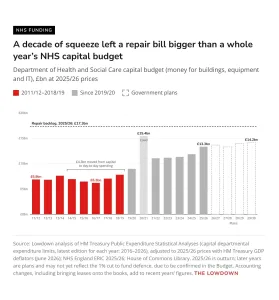
This cut comes as new figures show the NHS repairs backlog at its highest level. The latest Estates Returns Information Collection (ERIC), published on 15 October, puts the cost of clearing the backlog in England at £17.3bn in 2025-26, up 9% from last year. Much of this is repair work that should already have been done, not this year’s upgrades.
Almost £10bn of it is rated significant or high risk – problems that threaten safety or could force services to close. The backlog is now bigger than the £14.4 billion it costs to run the NHS estate for a year and bigger than the department’s entire capital budget of almost £14 billion for 2026-27.
Siva Anandaciva, Director of Policy, Events and Partnerships at The King’s Fund, said:
While many people understand the need to increase defence spending, cutting the NHS capital budget, which helps maintain NHS buildings and equipment, including MRI and CT scanners, will have a knock-on effect on patient care.
Impact on patient care
During this summer’s heatwaves, more than 1,100 operations were cancelled in England and Wales in just 17 days, according to Freedom of Information data gathered by Carbon Brief. They included hip and knee replacements, heart operations, and skin cancer removals. Operations were abandoned partway through and staff blamed broken or inadequate air conditioning or ventilation. Crawley Hospital alone cancelled 140.
In a Unison survey of more than 19,000 staff, published in June, 40% had seen buckets on the floor to catch leaking water, and 16% had experienced sewage leaks. Almost three in ten said wards or buildings had been closed for maintenance or safety reasons. Staff described dead rats rotting in an air conditioning unit and a roof leaking into a mortuary fridge.
Helga Pile, speaking for UNISON, said
Hospitals should make people better, not expose them to harm from rotting rats, raw sewage, and dilapidated buildings
Seven hospitals, largely built from RAAC concrete, will now not be replaced by its 2030 deadline. The National Audit Office has also warned that projects to rebuild at Airedale and West Suffolk are not due until 2033. Delays mean considerable expenditure in keeping them safe.
Trusts are having to support collapsed roofs with scaffolding and steel props to keep patients and staff safe,
said Dan Elkeles of NHS Providers.
Since the pandemic, NHS trusts have struggled to cope with the growing problems.
The government’s own 10 Year Capital Plan says that in 2024/25 there were 4,100 “clinical service incidents caused by estates and infrastructure failure”
Will capital funding be shifted into day-to-day budgets?
When day-to-day budgets ran short in the past, the NHS plugged the gap by raiding its capital budget. In the five years before 2020, it switched £ 4.3 billion this way. It continued in 2023-24, when the Department of Health moved almost another billion in capital funding into day-to-day spending to help NHS systems with their finances. But the government’s 10-year capital plan now claims its “new fiscal rules prevent the annual cycle of capital funding being used to shore up day-to-day spending.”
Under the current financial pressure, this will undoubtedly be put to the test. The King’s Fund has already reported that at a local level, NHS trusts are delaying building schemes to balance their books, despite growing repair backlogs.
Low real terms funding
Ministers point to the 10-year capital plan, which promises a health capital budget rising to £15bn by 2029-30, including at least £6.75 bn over the 9 years for the backlog and unsafe buildings, and £ 1.6 bn for the RAAC problem. Putting this in perspective, the Health Foundation calculates the capital budget will grow by just 1% a year in real terms to 2028-29, before accounting for this year’s higher inflation.
Extra costs?
Finance managers must also contend with inflation, which the Bank of England expects to rise above 4% early next year, further reducing what the NHS can afford to spend on maintenance and repairs. Other cost pressures will come from pay settlements that the government only partially funded and that health budgets must now absorb after Andy Burnham and John Healey recently refused Yvette Cooper’s request for extra funding, according to the Times.
The budget will rubber-stamp the 1% cut to fund defence spending, but the Treasury said it would confirm the remaining 4.7 billion in a fair and balanced way by finding efficiencies and cancelling or delaying lower-priority programmes. There’s been no suggestion that health will be asked to contribute more as yet. The Treasury has not said where the money will come from.

Dear Reader,
If you like our content please support our campaigning journalism to protect health care for all.
Our goal is to inform people, hold our politicians to account and help to build change through evidence based ideas.
Everyone should have access to comprehensive healthcare, but our NHS needs support. You can help us to continue to counter bad policy, battle neglect of the NHS and correct dangerous mis-infomation.
Supporters of the NHS are crucial in sustaining our health service and with your help we will be able to engage more people in securing its future.
Please donate to help support our campaigning NHS research and journalism.
