

Who sets the rules and what’s the ask?
Patient Care
NHS waiting times have improved, but the recovery is faltering. Since July 2024, the share of patients waiting no more than 18 weeks for planned care has risen from just under 59% to 65%. But the peak in March was helped by a last-minute cash injection and an unusual clear-out of the list, and since then performance has flatlined at 65.2% in August. The waiting list has started to grow again, and managers are now being asked to reach 70% by March 2027 and 92% by March 2029.
The Royal College of Surgeons says no region of England is on track to meet the 2029 target. Research by the Royal College of Physicians found the waiting list would need to halve to meet it. and the Health Foundation predict it will be missed “by a considerable margin.”
Progress toward cancer targets has barely moved. About 7 in 10 patients start treatment within 62 days of an urgent referral, up from 69% the year before. Last year’s 75% goal was missed. Managers must now reach 80% by March 2027 and 85% by 2029. The standard was last met in 2015.
Only about three-quarters of patients were admitted, transferred, or discharged within 4 hours, short of last year’s 78% goal. Every trust must now reach 82% by March 2027. Ambulances missed last year’s 30-minute average for serious calls, such as strokes, by just 4 seconds. This year, the target falls to 25 minutes, but in September, the average achieved was 31 minutes.
Finance
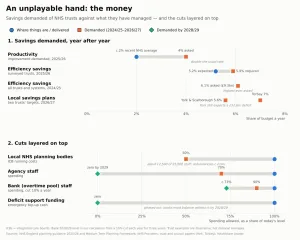
They have already delivered £10.2 bn of savings in 2025-26, 92% of which was planned, and agency spending almost halved from £2.1 bn to £1.2 bn.
Yet local NHS systems still finished the year £563 million in deficit, with 15 of them overspending. With the emergency deficit support cash now being withdrawn, balancing the books will take something close to a superhuman effort.
Workforce
Some cuts are set nationally. Agency spending must fall by a further 30% in 2026/27 and reach zero by 2029. Spending on bank staff, the NHS’s own pool of staff to cover rota gaps and overtime, must fall 10% a year. ICBs must halve their running costs, meaning about 12,500 jobs will be lost.
But other cuts are a local response to the government’s demand for savings. Research analysing a year’s worth of ICB board papers from 31 trusts in the North West found a consistent pattern. Twenty trusts set targets to cut staffing posts, at least 18 ran voluntary redundancy or resignation schemes, and at least 26 used vacancy controls or recruitment freezes. Despite this, 13 trusts ended the year with more staff than planned, as patient demand and safety forced them to abandon cuts.
The North West reflects the national picture. Unison’s Freedom of Information research found that trusts across England plan to cut thousands of posts by 2028.
Asking the impossible?
Senior managers are paid to take responsibility and are accountable for their performance. Chief executives can have their pay docked by up to £15,000 a year, and every trust is ranked in publicly available league tables. The Thirwell inquiry called for a personal duty of candour for every manager. Accountability matters, but the fact that managers are caught in a cycle of crisis affecting long-term planning (and even when they attempt to make dramatic cuts in staffing, they often fail because of patient demand and safety concerns) sends a clear message: there are some systemic issues to be addressed, and setting unrealistic targets is a dangerous impediment.
The strain is showing. A survey by Managers in Partnership found that 68% of managers on boards said work stress had made them ill. All those surveyed are working unpaid hours and 35% stated they intend to leave as soon as they could. Only 5% believed politicians valued their work.
One respondent told the union this was
the most unsettling and chaotic time I have experienced in my 25-year NHS career.
Official statistics say there are around 40,000 full-time equivalent managers in NHS trusts and planning bodies – roughly 3% of a workforce of 1.33 million across the NHS.
Their roles include chief executives and directors, as well as those in operations, finance, HR, and planning — but many clinical jobs also involve management and aren’t included in the total, so the statistics understate how much management happens and who does it.
Key evidence
-
Between 2010 and 2025, total NHS staff grew by 37% but managers by only 12%.
-
There is now one manager for every 33 staff, against one for every 27 in 2010 – a near-record low, according to the King’s Fund think tank.
-
The Darzi review reported UK spending on health-system administration and governance at 1.78% of health expenditure, against 2.98% across the 18 OECD countries compared.

Dear Reader,
If you like our content please support our campaigning journalism to protect health care for all.
Our goal is to inform people, hold our politicians to account and help to build change through evidence based ideas.
Everyone should have access to comprehensive healthcare, but our NHS needs support. You can help us to continue to counter bad policy, battle neglect of the NHS and correct dangerous mis-infomation.
Supporters of the NHS are crucial in sustaining our health service and with your help we will be able to engage more people in securing its future.
Please donate to help support our campaigning NHS research and journalism.
