• Health News,
  • Analysis,
  • Campaigns
  • SUPPORT US
  • Facebook
  • X (Twitter)
The Lowdown The Lowdown
  • News
    How NHS cuts are biting in England – a few tell-tale signs
    June 9, 2026
    Brutal cuts coming, NHS Alliance report reveals
    June 2, 2026
    More NHS outsourcing as management of bank staff contracted out
    May 12, 2026
    Staffordshire report gives clues on how the cuts have hit elderly and mental health
    May 1, 2026
    Mental health response failing patients with greatest need
    April 3, 2026
    Previous Next
  • Topics
    1. NHS Long Term Plan
    2. Mental health
    3. Outsourcing
    4. Building a sustainable NHS
    5. Safety
    6. Private Providers
    7. Quality
    8. Hospitals
    9. Community healthcare
    10. Access
    11. NHS@75
    12. View All
    Impact Statement shows why Labour’s 10-Year Plan is going nowhere
    February 6, 2026
    BMA votes to oppose 10 year plan for NHS
    September 22, 2025
    Private finance to power NHS move into community – other options?
    August 1, 2025
    How do promises on prevention of illness measure up?
    July 14, 2025
    Patients to be moved from “unacceptable” independent mental health hospital
    March 11, 2026
    Is government in denial over unfair treatment of mental health patients?
    October 2, 2025
    Mental health emergency response expanded
    June 23, 2025
    Children waiting and rejected for mental healthcare
    January 31, 2025
    Private companies target ADHD diagnosis sector
    February 12, 2026
    Government change course after lobbying on NHS spin-off companies
    September 29, 2025
    Time to act on profiteering from NHS eye ops
    July 28, 2025
    ICB pushes Shropshire GPs aside to bring in venture capital company
    July 19, 2025
    Government retreats from promises and targets
    February 6, 2025
    To get NHS out of this hole – stop digging
    January 19, 2023
    Worst-ever crisis set to get worse
    September 6, 2022
    Warnings for coming winter as NHS capacity reduced
    July 7, 2022
    GPs to enter dispute with Government over contract changes
    September 22, 2025
    Survey finds Scottish health staff are too overworked to report problems
    May 25, 2023
    UNISON survey shows leap in concerns over standard of care
    March 15, 2023
    Analysis: policy is a greater threat to patient safety than striking nurses
    December 20, 2022
    Palantir, the controversy, the contracts and the campaign against the FDP
    March 31, 2026
    Patients to be moved from “unacceptable” independent mental health hospital
    March 11, 2026
    Private companies target ADHD diagnosis sector
    February 12, 2026
    PFI: Still draining NHS budgets decades on
    February 6, 2026
    Maternity safety compromised in a third of NHS trusts
    July 9, 2021
    CQC calls for intervention at failing trust
    July 21, 2020
    10 questions to ask about the NHS deal with the private hospitals
    June 23, 2020
    Too few midwives and too little funding continues to affect safe maternity care
    March 18, 2020
    Brutal cuts coming, NHS Alliance report reveals
    June 2, 2026
    PFI: Still draining NHS budgets decades on
    February 6, 2026
    Critical incidents signal emergency departments beyond safe limits
    January 21, 2026
    Streeting admits that the financial squeeze on hospitals is undermining patient care.
    January 19, 2026
    Reverse the “dire state” of community nursing
    November 10, 2025
    Mental health procurement found to have major issues
    October 7, 2025
    Neighbourhood health care could stretch NHS budget to breaking point
    April 16, 2025
    Push for virtual wards an opportunity for the private sector
    May 4, 2022
    How NHS cuts are biting in England – a few tell-tale signs
    June 9, 2026
    End of life care in need of cash transfusion
    April 21, 2026
    Do claims of waiting list improvement stand-up?
    September 27, 2025
    Delayed discharge explainer: health and care pressure
    February 24, 2025
    Explainer: NHS funding after the spending review
    June 16, 2025
    Private equity: the new face of privatisation?
    April 20, 2024
    Why we need more public health services
    February 1, 2024
    10 reasons why sustained NHS funding rises are unavoidable?
    July 5, 2023
    How NHS cuts are biting in England – a few tell-tale signs
    June 9, 2026
    NHS PENSION SCANDAL: How BSW Hospitals Group cut pensions to meet savings targets
    May 27, 2026
    End of life care in need of cash transfusion
    April 21, 2026
    No clear plan for newly-shrunken ICBs as new failure regime kicks in
    April 14, 2026
    Previous Next
  • Analysis
    1. Comment
    2. Long read
    3. View All
    NHS chiefs frightened to share the facts?
    June 3, 2026
    Despite all the evidence, NHS chiefs turn again to management consultants
    May 22, 2026
    Beware of Streeting’s selective statistics as he bids for top job
    May 15, 2026
    GPs block data sharing in fight over new contract
    May 6, 2026
    Private equity – “decimated” US hospitals according to report – now targeting the NHS
    September 2, 2025
    Ignore bizarre business advice: use PPUs to treat NHS patients
    August 2, 2024
    ICB financial squeeze set to tighten
    April 25, 2023
    It’s high time ministers and NHS took staffing crisis seriously
    February 6, 2022
    NHS Modernisation Bill – all roads lead to less accountability to patients and staff
    May 18, 2026
    Beware of Streeting’s selective statistics as he bids for top job
    May 15, 2026
    Neighbourhood Health Centres – not local, not centres, and inefficient
    April 22, 2026
    Scoping the cuts – NHS systems’ finance and staffing in the North West
    March 20, 2026
    Previous Next
  • Explainers
    How NHS trusts are forced to run deficits — the planning cycle explained
    June 10, 2026
    DATA: NHS use of private hospitals falls after steady post pandemic rise
    April 5, 2026
    Palantir, the controversy, the contracts and the campaign against the FDP
    March 31, 2026
    ICB WATCH: How bad are delayed discharges in your area?
    January 30, 2026
    How big is the problem of long-stay patients?
    January 13, 2026
    Previous Next
  • Last 100 articles
    • Back issues
  • ICS WATCH
  • Campaigns
    1. Keep Our NHS Public
    2. Health Campaigns Together
    3. View All
    Previous Next
  • Search for:
Accountability Comment Integrated care

ICBs offer no real place for accountability

June 30, 2022
Share
Facebook Twitter LinkedIn Email

Comment by writer and campaigner John Lister


One of the stock, unconvincing answers to those who have challenged the lack of local accountability in the new system of 42 “Integrated Care Systems” (ICSs) that will take over control of England’s NHS at the start of July has been to claim that many decisions in the larger ICS areas would be taken at more localised “place” level.

This has been a key factor in winning endorsement from the Local Government Association for a system that in reality keeps the NHS firmly in charge, but makes use of  local councils to give a spurious veneer of more democratic and local involvement.

Exactly how much difference, if any, place-based organisation might make – especially when the dominant pressure is the financial constraints on ICSs and requirement to eliminate deficits, and with no place-level decision-making body, no public representation, little or no public access to the executive lead, and minimal, if any, information on potentially controversial issues in local news media – has not been explained.

But too many it will look like a sham.

As the new system, which has been put in place with the barest minimum of pretence of public involvement or consultation, sits on the launch-pad, a June 23 report by the Health Service Journal, based on research in May and June, has revealed that half of the ICBs have not even appointed the bureaucrats to lead the “places,” which are not expected to be functional until the autumn.

The HSJ calculates 39 of the 42 ICSs between them are set to establish 175 “places,” while three single-county ICSs (Gloucestershire, Lincolnshire and Somerset) have decided not to establish any more local bodies.

Each ‘place’ is supposed to have a single leader, accountable to the newly-established Integrated Care Boards (ICBs). But only 16 ICBs have chosen “some or all” of these executive leads. Of those who have been appointed:  “The majority are CCG/ICB executives or local council executives, with a significant minority being NHS provider chief executives.”

Supporters of the changes have also argued that, in line with the letter of the Health and Care Act, ICBs which will have the full statutory powers and control of budgets will also have to “have regard to” the local strategy drawn up by broader Integrated Care Partnerships, (ICPs) which are supposed to link up the NHS with local government and other “partners”.

But the HSJ reveals only 21 of the 42 ICSs have so far even appointed their ICP chair: nine of these turn out to be also the ICB chair, underlining a complete lack of any independence of the ICP. Most of the rest are councillors.

So even before the new system creaks into gear it’s already embarrassingly obvious that the ICPs, non-statutory bodies with only the most tenuous and theoretical role or influence, and created as a sop to appease local Tory councillors, are a marginal, irrelevant appendage to each ICB that nobody will take seriously.

As we have consistently warned in The Lowdown, the new system of ICSs/ICBs marks a major further erosion of local public accountability, and the challenge for campaigners will be to keep track of changes and policies as they take shape at ICB level.

Meanwhile the Health Foundation has published a useful new study highlighting the huge variation between ICBs. It shows the range of population covered – between 500,000 and 3.1m; the varying levels of deprivation; the varying levels of potentially avoidable use of emergency and hospital care; the elective care backlog;  and the near 50% variation in provision of GPs – which once again confirms the famous “inverse care law” highlighted in 1970 by Dr Julian Tudor Hart, noting that the areas with the greatest levels of deprivation consistently also had the fewest GPs per head of population, while the wealthier, healthier populations were far better provided. Even now NHS England is still only talking about this issue rather than taking any action.
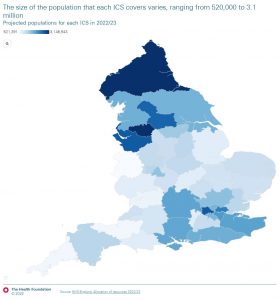
Over 50 years on, with inequalities in health and in living standards widened by a decade and more of cynical government policy, a new “inverse rhetoric law” brings us more empty government words about “levelling up” the wider the gap becomes between richest and poorest.

Integrated Care Systems, established in a new wave of austerity, with Health Secretary Sajid Javid insisting that the NHS does not need and should not receive any more funding, will resolve none of this: nor indeed can ICSs address the parallel, hopeless privatised shambles of social care. And without functioning social care, the NHS cannot hope to free up the flow of patients through the hospital system.

As the new ‘reformed’ system launches as a half-arsed, chaotic, cash starved mess, under a smokescreen of unreadable and empty rhetoric, it’s up to campaigners, the unions, any local politicians who really care about their constituents and any NHS managers with a shred of self-respect to fight to expose the contradictions and gaps, challenge the short-sighted cutbacks and panic measures that are likely to follow in the autumn, and try to defend the services we all depend upon.


Dear Reader,

If you like our content please support our campaigning journalism to protect health care for all. 

Our goal is to inform people, hold our politicians to account and help to build change through evidence based ideas.

Everyone should have access to comprehensive healthcare, but our NHS needs support. You can help us to continue to counter bad policy, battle neglect of the NHS and correct dangerous mis-infomation.

Supporters of the NHS are crucial in sustaining our health service and with your help we will be able to engage more people in securing its future.

Please donate to help support our campaigning NHS research and  journalism.                              

DONATE
accountabilityhealth foundationICBicsintegrated care partnershipintegrated care systemspublic engagement
0
Author John Lister

Related Posts

NHS chiefs frightened to share the facts?

June 3, 2026

Despite all the evidence, NHS chiefs turn again to management consultants

May 22, 2026

NHS Modernisation Bill – all roads lead to less accountability to patients and staff

May 18, 2026

Beware of Streeting’s selective statistics as he bids for top job

May 15, 2026

GPs block data sharing in fight over new contract

May 6, 2026

No clear plan for newly-shrunken ICBs as new failure regime kicks in

April 14, 2026
  • Receive out latest content


    • Recent
    • Popular
    • Tags
  • Navigation
    • About us – campaigning journalism on the NHS
    • Support Us
    • Editorial Policy
    • Cookies and Privacy Policy
    • Contact
  • Recent
    • June 10, 2026

      How NHS trusts are forced to run deficits — the planning cycle explained

    • June 9, 2026

      How NHS cuts are biting in England – a few tell-tale signs

  • Facebook
  • X (Twitter)

© 2025 Centre for Equitable Healthcare | All rights reserved | Company No: 8162172

Top
The Lowdown

    Type above and press Enter to search. Press Esc to cancel.

    Accessibility Adjustments

    Powered by OneTap

    How long do you want to hide the toolbar?
    Hide Toolbar Duration
    Select your accessibility profile
    Vision Impaired Mode
    Enhances website's visuals
    Seizure Safe Profile
    Clear flashes & reduces color
    ADHD Friendly Mode
    Focused browsing, distraction-free
    Blindness Mode
    Reduces distractions, improves focus
    Epilepsy Safe Mode
    Dims colors and stops blinking
    Content Modules
    Font Size

    Default

    Line Height

    Default

    Color Modules
    Orientation Modules